
Future Screens NI Spotlight - Multimedia

Multimedia:

Multimedia forms a large section of the space Future Screens NI works in, with a particular view to how this sector is being innovated upon. Some of this innovation comes from new technologies such as 360 cameras, VR/AR headsets, Realtime Rendering pipelines ect. and how they can be used to change the shape of the industry, but these innovations also come from how this technology can be utilised in ways that were previously not possible, by employing newly emerging techniques. Some of the most interesting companies we work with are combining both of these methods to create entirely new workflows and products that can lead the industry in a new direction and also put the Northern Irish creative sector as a whole firmly on the global stage.


Retinize: Retinize is a multi-award-winning immersive media studio, creating VR and AR experiences for clients like National Geographic, BBC, Seagate, BMW, National Museums NI etc.

Their mission is to create new and incredible immersive experiences that push the boundaries of what the viewers/users are typically expecting from similarly designed content and what the medium (VR/AR) is currently capable of. The overall goal for Retinize is to harness this newly expanding medium by using a full spectrum of available technologies to get the absolute best out of the content. To do this they use state of the art 360 video, 3D stereoscopic vision and spatial sound to truly immerse the user in breathtaking content. By doing this they believe that they will be able to get more people to fully embrace a new form of story telling that is able to instantly transport a user to an entirely new world.
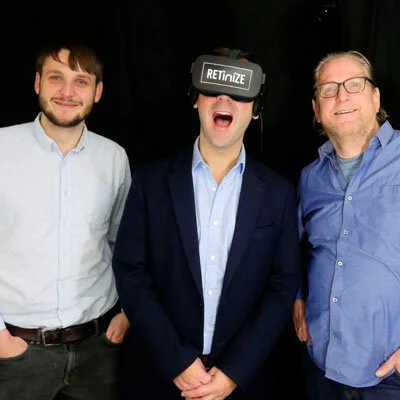
RETiniZE-Techstart.jpg

Retinize initially began as a spinout from Wild Rover Productions which had been well established in Northern Ireland since 1999 as a film and production company. From here Retinize established their own roots in high end global film and television before going on to explore more tech focussed projects which include VR/AR experiences that were created for  National Museums NI and Tourism NI in addition to further utlising the technology for animation techniques and more advanced production that can not only be used internally for the creation of high end video pieces but also has the potential to change how the industry as a whole thinks about animation techniques and production.

For More on Retinize: https://www.retinize.com


ALT Animation: ALT is a collective of creative professionals who joined forces to create a production studio focused on delivering high quality story driven animated content, using efficient production pipelines to provide creative solutions and compelling content for global audiences of all ages across multiple platforms. Formed in 2016, ALT Animation is made up of Animation Producers, Tim Bryans and Andrea McQuade and Creative Director Lee McQuade. Together they have over 30 years of experience in the creative industries during which they have produced dozens of hours of award winning broadcast animated content, helped to raise in excess of £15 million in production finance, developed numerous iOS Apps as well as created and produced campaigns and adverts that have been viewed right across the globe. They have worked for international broadcasters such as CBBC, Disney, Nickelodeon, PBS Kids, RTE, KiKA and Channel 4, and global brands such as Unilever, O2, Mars and Vodafone combining their production management and creative experience to deliver award winning material with exceptionally high production values.

hearios.jpg

Their newest project “The Hearios” is an exciting stop motion animation and live action mixed media series aimed at a pre-school audience featuring a family of musical moles who teach children the important developmental skill of active listening. 

Since their formation, ALT Animation have been focused on developing a slate of animated properties for the global market. In 2017 ALT Animation optioned an idea for an animated series from children’s author and music expert Ann Bryant.

Working with Ann and Mark Gordon of Score Draw Music, ALT have developed the idea into The Hearios, a property with true international appeal which promises to couple compelling animated content with a very valuable message for a modern pre-school audience.

In the current market, the competition for commissions from broadcasters and SVODs is extremely high with production companies from around the world competing for the relatively small number of shows that get picked up every year. The children’s department at the BBC receive over 1,000 pitch documents every year, from which they will commission 3 or 4 projects. Whilst the BBC are obviously the market leader in children’s animation, this level of uptake is indicative of the competition that animation producers face to get their content out into market.

ALT.jpg

In order to make The Hearios stand out from its competitors, ALT are proposing to bolster their current proposition by carrying out user testing with our target audience, in collaboration with QUB, to provide information about the existing listening skills and vocabulary of pre-schoolers and how they are affected by the central conceit of the show. The series has been designed to improve children’s active listening skills which have been shown to assist with their development in areas such as speech, language skills and memory. ALT propose to carry out some user testing in order to establish the effectiveness of the show in capturing children’s attention to the sounds presented and their development of a vocabulary of sounds. Educational aspects of a series are of huge importance to broadcasters, especially public service broadcasters who have a particular remit to inspire and educate their audiences.

For More on ALT Animation: https://www.altanimation.com


Italic Pig: Italic Pig is an innovative games studio based in Holywood that specialise in high-concept narrative adventures packed with snappy dialogue, irreverently-epic plot lines and experimental game mechanics.

The premise for their new VR game “The Infinite Hotel” came from working within VR’s key limitation - physical  space - rather than fighting against it with workarounds like teleportation, autorun or stick  controls.  Italic Pig’s The Infinite Hotel is a character-driven VR adventure that boasts “A grand scale  adventure in a room scale space”. Set in a hotel with an infinite number of floors, the player  takes on the role of elevator operator to the weird and quirky staff and patrons of the  universe’s most luxurious holiday resort. Though The Infinite Hotel has achieved recognition, the current Character Generator does not function to the level Italic Pig wish to provide. Italic Pig aim to create a second generation Character Generator that uses fewer assets in an innovative method, and uses machine learning to create believably randomised characters (known as “Randos”) that are appealing to the player.

infinite.jpg

The game won The Big Indie Pitch at PocketGamer London and  earned a highly regarded Best In Play award at GDC San Francisco. Both Oculus & HTC have  shown genuine interest, and the demo has been compared to “stepping into a Pixar film”.   Italic Pig have been recognised as NI Game Studio of the year.  Infinite Hotel was nominated for Best Immersive  Game at the upcoming ​Raindance Film Festival​ 2019. 

The Trailer for The Infinite Hotel can be accessed here:

https://www.youtube.com/watch?v=4kavlSIDXzo

For More on Italic Pig: https://www.italicpig.com


For more information on the projects that have been funded through future screens NI and how to go about applying for funding yourself please follow the link below

futurescreens.org/funding

Future Screens NI and Experimental Design LA win Best International Collaboration

Future Screens NI and Experimental Design LA  and partners where delighted to win the award for Best International Collaboration at the Education Awards which recognise excellence in the third level education sector in Ireland.

The award recognised the important impact of the partnership between Future Screens NI and Future Technologist Alex McDowell in widening success with the creative industries within under-represented communities.  Professor Paul Moore and Alex McDowell are pioneering a ground-breaking worldbuilding framework which is transforming the creative industries for good across Northern Ireland. 

The award also recognises the contribution of all industry partners and SMEs working actively within the Cluster.  Moya Doherty Future Screens NI Industrial Champion and co-founder of Riverdance collected the award on behalf of Future Screens NI.  Alex McDowell flew in from LA to represent Experimental Design at the Awards Ceremony.

For a brief overview of Future Screens NI: https://vimeo.com/372602129

“Primary "School teachers report low levels of confidence in using computers and digital devices”

Research by Ulster University has shown that Primary Schools teachers have reported low levels of confidence when using computers and digital devices. The report “Digital Education in Primary Schools” authored by Professor Linda Clarke  shows that just 57% of Teachers participating in the study reported that they felt fairly confident when using computers and digital devices.  A further 10% reporting that they felt threatened by the thought of using a digital device.   The report is to be launched by the NI Commissioner for Children and Young People,  Koulla Yiasouma on Thursday the 16th of January at the Ormeau Baths Innovation Hub at an event hosted by both Future Screens NI and Northern Ireland Screen, organisations which are at the cutting edge of rapid advances in digital technology. 

The recommendations within the report point towards the need for greater investment in, and a more strategic approach to Digital Education. Northern Ireland is the only region within the UK without a Digital Strategy. The last long-term development plan and ICT framework for ICT policy was set out by the government over two decades ago, namely: the ‘Strategy for Education Technology in Northern Ireland’.

Speaking in advance of the launch of the report Professor Linda Clarke, Research Director-Education at  Ulster University said:

“The Digital Education in Primary Schools Baseline report shows a decline in teachers confidence when using computers and digital devices.  It is essential that this is reversed and that Digital Education is properly resourced and prioritised.

The New Decade, New Approach document and the establishment of New Northern Ireland Executive has generated an as yet unmet opportunity to prioritise Digital Education, Digital Skills and the use of New and Emerging Technologies within Schools.  Therefore I am calling on the New Northern Ireland Executive to commit to addressing current deficits in digital education by investing in digital skills and to work together to produce a Digital Strategy which ensures that digital literacy has the same level of priority as numeracy and literacy.   We have gathered key stakeholders together to commence the process of joint working and planning in order to kick start a more coordinated approach to Digital Education and Digital Skills”

Speaking in advance of the launch, the NI Commissioner for Children and Young People, Koulla Yiasouma said:

“Today’s generation of children and young people is the first to have truly grown up in the digital world. As adults we have a responsibility to ensure that they are protected from harm in this space and that they are fully equipped to harness its many opportunities.”

“This report reflects many of the areas that must be addressed within the education system including supporting our teachers to educate and support our children as well as having a curriculum that is fit for the 21st century.”

Speaking in advance of the launch, Sara Long, CEO of the Education Authority said:

“EA has an ambitious vision to inspire, support and challenge all our children and young people to be the best that they can be. We are challenging ourselves to lead by example in the use of technology and digital to deliver excellent education support services that enable better outcomes for children. I welcome the “Digital in Education in Primary Schools Report” as a valuable resource to further inform our planning in this area.”

Executive Report Summary

Full Report

Future Screens NI is running a free workshop on storytelling in the interactive sector, Saturday 30th November from 2-5pm in the Seamus Heaney Centre, Queens University

Future Screens NI is running a free workshop on storytelling in the interactive sector (VR/AR/Gaming). Super Story World will take place on Saturday 30th November from 2-5pm in the Seamus Heaney Centre, Queens University and will be lead by author, Stephen Sexton.

In this workshop, you will analyse video games’ relationship to narrative, and the ways in which concepts of narrative might be used to invigorate and transform games. The discussion will consider relationships of text and image as well as plot, character and perspective as well as the potential of the video game to tell new and uniquely realised stories.

The workshop is open to anyone with a professional background in gaming and has limited spaces so attendance will be on a first come first serve basis. Please RSVP to r.brown@qub.ac.uk

https://www.northernirelandscreen.co.uk/news/futurescreens-ni-host-free-storytelling-workshop-interactive-sector/

Northern Ireland’s leading video game development company commits to a four-day working week to maximise creativity and employee wellbeing

The video game industry made headlines earlier this year when it was exposed that a number of globally-leading companies had been pushing their development teams to work upwards of 100-hour weeks to meet publishing deadlines.

The backlash that followed revealed that, despite the idea that working in video games is considered a ‘dream job’, this level of pressure is commonplace in the industry. High-pressure unpaid overtime, known as ‘crunch’, is a common practice that companies demand of their employees to hit near-impossible production deadlines. Demands on employees are generally so stressful that anyone in the industry longer than 5 years is considered to be a ‘veteran’.

Northern Ireland game development company Italic Pig are making a radical move in the opposite direction, by adopting a four-day work week.

“Creativity is not something that can be forced, and it’s ridiculous to think that perpetual stress, crunch, and lack of sleep won’t have an impact on the quality of that creativity,” says Kevin Beimers, CEO of Italic Pig.

“I’ve worked in enough studios where magical schedules are conjured up from a basic formula of ‘work to be done divided by time to do it’, no matter how impossible the workload may be. This formula inevitably results in employees being forced to work nights and weekends for months at a time, with the blame being put on them when these impossible deadlines aren’t being hit.”

“In my experience, the best creative output comes when stress is low, energy is high, health is good, and the work environment is positively charged. Now that I run my own creative company, that’s what we’re aiming for here.”

The company has always put a high priority on the mental and physical health of its team both inside and outside of the workplace - skills development, employee perks packages, random talent challenges and internal health & fitness competitions - but the four-day work week is their most radical decision yet.

“The four-day week actually started off as a cost saving measure,” explains Kevin, “Finding funding for creative development is always a lengthy and unpredictable process. Having assembled a kick-ass team of top talent, I was loath to lose any of them as funds began to dwindle between projects. So, to keep everyone together, we suggested a proposal: let’s drop everyone’s salaries by 20%, and close the office on Fridays.

“With this sacrifice came a challenge: If we as a company found that we could achieve in four days what would traditionally take five, without undue stress, simply through efficiency and energy, then, when the next round of funding comes in, we’d bump the salaries back up to 100%, but stick to the four-day week.”

And that’s exactly what happened.

Italic Pig recently signed a deal to collaborate with The Irregular Corporation and Northern Ireland Screen to produce Paleo Pines, a dinosaur-ranching social management sim. Whilst the full production budget is undisclosed, it represents the largest video game investment into Northern Ireland to date. It’s getting done smoothly, efficiently and stress free, four days at a time.

To produce the Paleo Pines title, Italic Pig recently recruited 7 new members to its team. Several of the new hires cited the four-day week as one of the most enticing benefits of joining the company.

Recent hire Britt Bailey explains, “ The four-day work week was one of the things that really sold me on the decision to come over to Belfast from England to work for Italic Pig. It stood out to me as something no other studio I applied for had offered and made me confident that I'd have a good work/life balance at the company.”

With a highly-skilled, diverse team of 19 people, varying in age from 21 to 44, the management team at Italic Pig was eager to not merely follow best practice guidelines, but exceed them to create a business culture that suits everyone.

“We pay our staff competitive, industry-standard salaries for a full week,” explains Ross Morrison, Head of Production. “The producers and line managers lay out achievable estimates for the week, and the employees endeavour to get that work done in four days. Friday is still there as a ‘just in case’ - contingency, slippage, or the unexpected hiccup in production - but more often than not, Fridays are the first day of the weekend.”

Since starting the four-day week, the team at Italic Pig has seen a huge increase in focus, with the team eager to meet their well-considered deadlines. “If anything, the team is more efficient now than they ever were, not to mention happier.”

Recent research is backing up Italic Pig’s approach. Autonomy , in their August 2019 research into the four-day week, found that there is no positive correlation between hours worked and productivity. Nowhere is this more relevant than in the creative industries. Forcing creative and programming teams to work 100-hour weeks doesn’t result in better games; it simply results in a crew that is burnt out and resentful.

“Italic Pig have never been your standard company,“ offers Amelia Lingman, COO. “We are in the position of being able to shape our own creative environment that we can be proud of, one that we would have enjoyed working in when we first started out in the industry. We want to show that an indie studio can be just as productive and successful, if not more so, by putting the emphasis on creativity and balance, rather than constant pressure from above.”

“We want the studio to enjoy working on each project, not just breathe a sigh of relief when it’s released.“

Not only does a 4-day week allow for far better balance, but makes sense from a recruitment and efficiency perspective as well.

Recruitment of highly talented designers and programmers is one of the more costly aspects of running an indie video game studio, particularly in an industry where turnover is typically high. Furthermore, the loss of a trained employee has a huge impact on a well-managed pipeline.

Impressively, in their 7 years of business, although they have periodically had to shrink and grow the team to fit their project load, they have maintained a turnover rate of zero. Not a single team member has ever chosen to leave Italic Pig in favour of another opportunity.

Noel Watters, Italic Pig’s Lead Programmer, explains: “I’ve been with Kevin for four years now. As an experienced programmer, I’m aware of the fact that there are other opportunities out there, but the work environment here is all about creative quality and doing things right, not just doing it fast. That sort of environment is hard to find, and the four-day week is even harder to beat.”

Italic Pig have also seen a decrease in the number of days that employees take off for life admin.

In the UK, life admin can cause the average person to lose over eight days of work per year, and most people still feel they don’t have a proper handle on it. With a four-day week, doctor’s appointments, mortgage meetings and MOTs can fit into the week smoothly without upsetting the core workflow, and with no detriment to annual leave.

Besides life admin, employees are encouraged to use their free day to explore their own creative interests, and spend time with their families, ensuring that the team returns on Monday morning fully recharged. All of this leads to a more productive work week and a happier team.

“If someone tells you ‘that’s just how things have always been done’, that’s the worst reason to do it,” Kevin explains. “As the head of one of the largest game development companies in the country, I’ve got the power to choose which trends I want to follow, and the power to make changes to the ones I don’t.”

“How can we expect to make fun, creative products if the work environment is exactly the opposite? If we do our part to make the work environment as creative and enjoyable as the games we produce, and other companies see what we’re doing and join us swimming against the tide, maybe working in video games really can be the dream job everyone thinks it is.”

www.italicpig.com

Italic Pig is a kickass Northern Irish entertainment studio filled with creative, talented and

attractive individuals. We create sarcastically epic, narrative-driven stories for all

audiences and platforms, and occasionally win awards for them. Italic Pig were recently

nominated for Best Immersive Game at the Raindance Film Festival, and have won a

GDC Best In Play, a number of Big Indie Pitch competitions and Northern Ireland Studio

of the Year in 2018 & 2019.